
Ardmore City Directory Collections
The verified local run is R.L. Polk & Co.'s Ardmore City Directory, documented from 1904 through 1960 in an Oklahoma Historical Society historic-resource survey. Ardmore Polk volumes offer annual name, address, occupation, business, and street or householder material. They are the core historical shelf, but not the only useful source. The Ardmore Public Library, the Oklahoma Historical Society Research Center, and Gateway each preserve a different part of the local record trail. An Ardmore collection result should be read with its year and section in mind.
| Ardmore collection | Years represented | Where held | How to use it |
|---|---|---|---|
| R.L. Polk & Co. volumes | 1904 to 1960 verified | OHS Research Center and directory search | Annual name, address, occupation, street, and business entries |
| Ardmore High School yearbooks | 1905 into the 2000s | Ardmore Public Library genealogy resources | Names, portraits, class activities, and school-era context |
| Daily Ardmoreite | From 1893, with digitized variation | Gateway to Oklahoma History | Notices, obituaries, social columns, and local business references |
| Local reverse directories | Not confirmed as a named Ardmore run | Ask Library or OHS reference staff | Do not assume address-order volumes exist until a catalog confirms them |
OHS describes these annual volumes as sources that can contain names, addresses, occupations, agencies, and classified businesses. Exact Ardmore call numbers and a complete digitized Polk run were not located in the research, so the reliable fallback is the OHS directory search or a request for help at the Research Center. Note: A missing volume may be an access gap, not proof that a household left Ardmore.
Ardmore's Polk Directory Run
The Ardmore Polk run is a valuable bridge across decades because it places names beside streets and occupations in repeated annual Ardmore volumes. It can help distinguish two people with the same surname, especially when one entry changes address while another stays put. Still, a listing is not a deed, a census return, or proof of identity. A person may appear as a business contact, a householder, or an occupant in the street guide, and those roles are not interchangeable.
For a person whose name changes over time, search initials, middle names, maiden or married surnames, and business names. The 1922 Ardmore directory notice shows that one volume separated its citizens and firms material from its street and householder guide. That internal split matters: an address finding should be checked in the name material, and a name finding should be checked against the street guide when the volume supplies one.
| 1904 | The earliest year in the verified R.L. Polk & Co. Ardmore run. |
|---|---|
| 1922 | The Daily Ardmoreite notice describes the volume's 448-page structure. |
| 1960 | The last year verified by the OHS historic-resource survey, not a confirmed final printed issue. |
- Choose the Ardmore volume closest to the target year and record the volume year before taking notes.
- Search the surname or business name, including initials and spelling variants.
- Check the street or householder portion when an Ardmore address appears.
- Compare the next available volume to see whether the entry changes or disappears.
Reading an Ardmore City Directory Entry
An Ardmore city directory entry needs its surrounding context. Record the spelling exactly as printed, then note whether the entry comes from the name list, street guide, business list, or a civic listing. The Ardmore research supports common entry elements such as a name, street and number, occupation or business, householders in the street guide, affiliations when listed, and volume or page. It does not support guessing a standard owner symbol, spouse notation, or abbreviation meaning for every Ardmore volume.
| Name as printed | Preserve initials, spelling, and any business or estate wording. |
|---|---|
| Street and number | Use the exact Ardmore street form, including directional wording and cross-street context when shown. |
| Occupation or business | Useful for separating similar names and for an Ardmore newspaper search. |
| Section of volume | Mark whether it is a name, householder, business, classified, or civic entry. |
| Volume year and page | The key needed to return to the original entry or compare nearby years. |
- Householder index
- An address-oriented part of a directory that names householders or occupants by street where the volume includes it.
- Criss-cross directory
- A directory organized by address instead of surname. No named Ardmore run was confirmed, so ask reference staff rather than assuming one exists.
- Abbreviation key
- The volume's own guide to shortened terms. Read it before expanding a label in an entry.
Note: Copy the section and volume year with an Ardmore entry, because an address listing and a business listing can describe different roles.
Ardmore's 1922 Directory, 448 Pages
A 1922 notice in the Daily Ardmoreite gives a rare description of what one Ardmore directory contained. It reported 448 pages in all: 28 pages of civic and institutional material, 62 pages of street and householder information, 252 pages of citizens, firms, and corporations, and 71 pages of classified businesses. Those counts describe that 1922 volume, not every year in the series. They do show why a surname search alone can miss an address-oriented or organization-oriented lead.
View the 1922 Ardmore directory notice before relying on its structure. The capture below shows the source item that preserves this useful account of the volume.
The page count helps set expectations for Ardmore historical research: a street clue may lead to a householder section, while a business clue may live in another part of the same book.
Ardmore Directory Work at the Library
The Ardmore Public Library is the practical local stop for historical context around an entry. Its collections page identifies extensive genealogy and local-history holdings, the Oklahoma Collection, McGalliard photographs and documents, research help, microfilm, and interlibrary loan. The genealogy page also points to in-library census and subscription resources, local obituaries, yearbooks, tribal resources, and other finding aids. A librarian can help locate a collection, but patron material-use records remain confidential and are not a search tool.
The Ardmore Library collections page is the best source for its local-history access channels. Its capture is included here because the collection combines physical materials and online McGalliard documents.
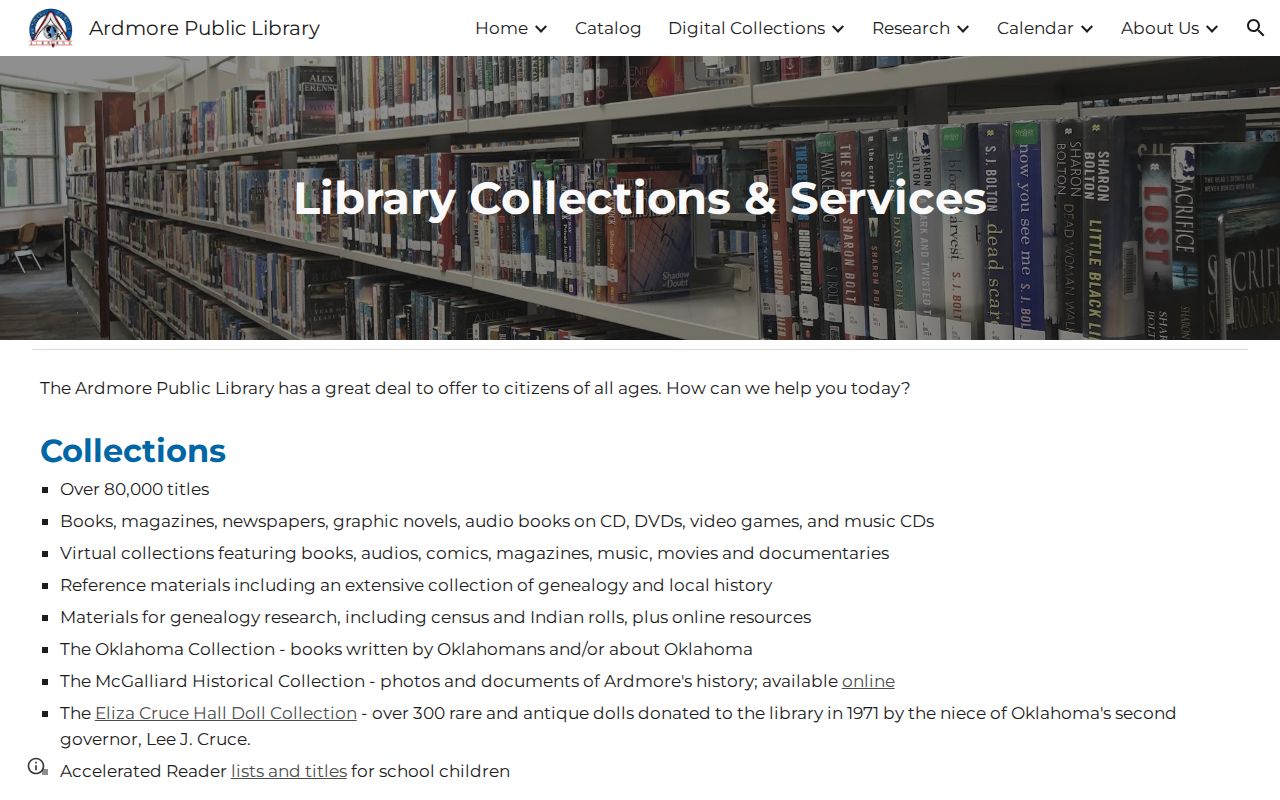
Microfilm is identified in the Ardmore Library adult reference area, while interlibrary loan can take weeks and may involve lending fees. Those alternatives are useful when a needed volume is not on hand.
The library policy manual, updated in June 2026, also names genealogical materials, Daily Ardmoreite microfilm, the McGalliard collection, and librarian assistance.
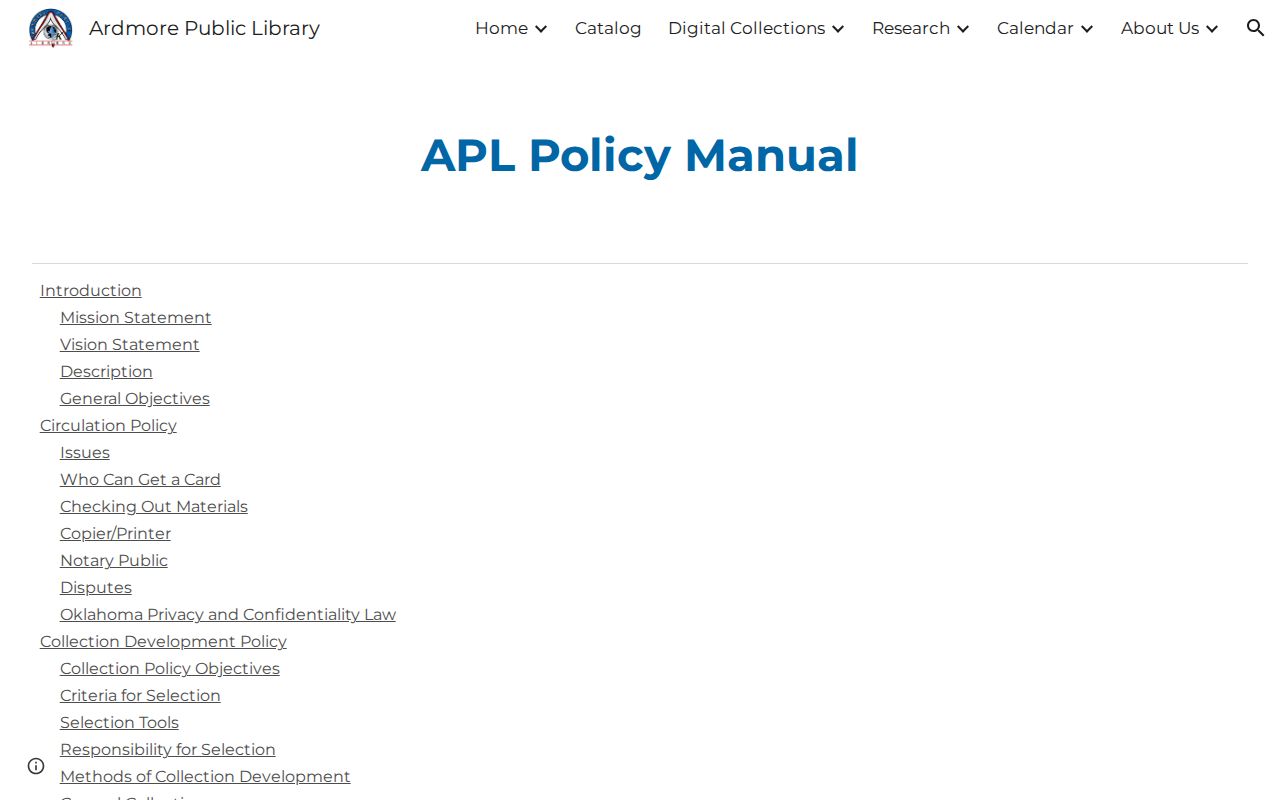
That policy is a reminder to verify present hours, database availability, and any service charge before a visit.
Ardmore Directory Research at OHS
The Oklahoma Historical Society Research Center adds statewide depth to an Ardmore search. Its catalog and genealogy resources include directories, telephone books, census and registers, yearbooks, newspapers, cemetery books, family histories, and American Indian records. The visitor information lists free Research Center access Tuesday through Saturday, with paid research and copy work available through a separate service. OHS says it does not conduct phone research, so its online directory search and staff channels are the better starting points.
The Oklahoma Historical Society Research Center is especially useful when an Ardmore library source needs to be paired with a census, newspaper, record guide, or a directory from another Oklahoma place.
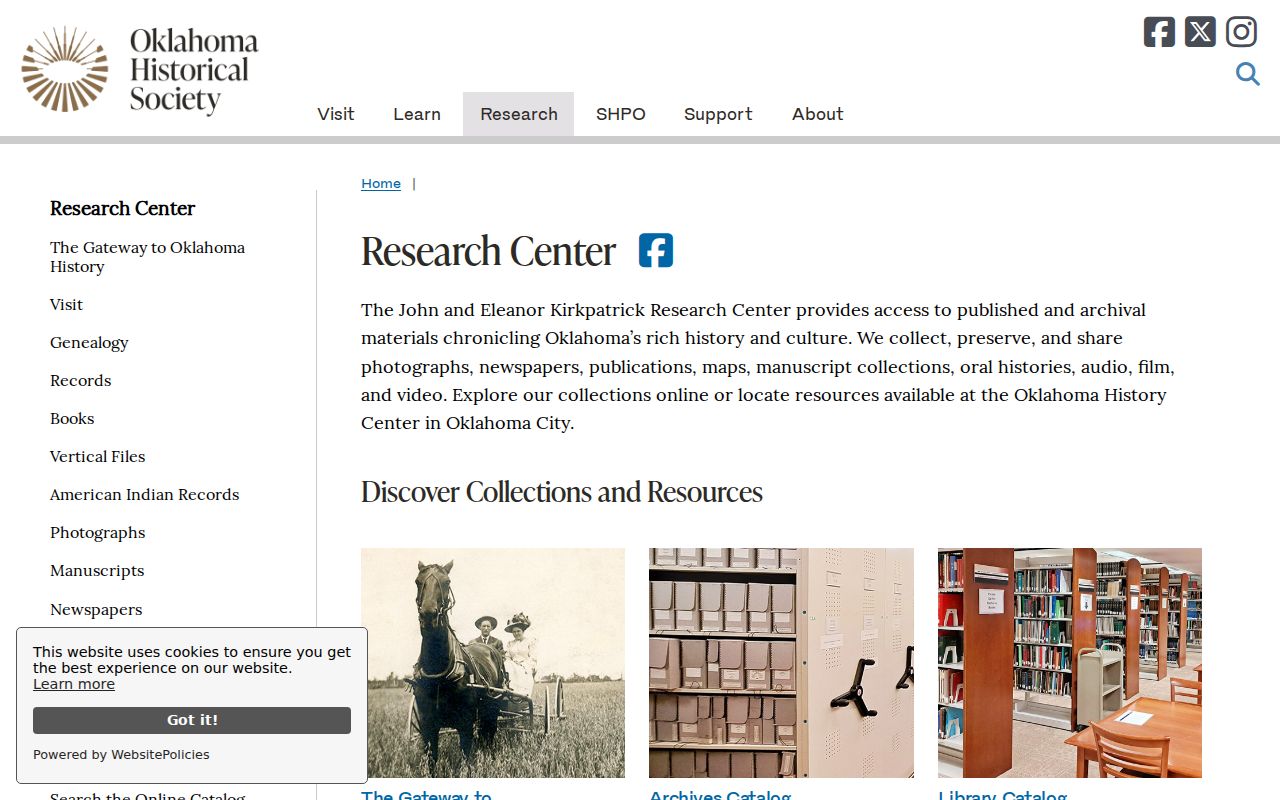
For paid Ardmore research, OHS lists resident research at $25 and out-of-state research at $35, while its published service lists additional categories and copy charges. Ask about the exact collection and current service terms before ordering.
Note: OHS access details can change, so confirm Ardmore collection availability and service terms before a trip or paid request.
Ardmore Directory Clues in Yearbooks
Directory entries identify an address and often an occupation. Ardmore High School yearbooks add school-era names, portraits, activities, faculty, and sometimes address context. The library identifies digitized yearbooks from 1905 into the 2000s. They are useful for reconnecting family members, confirming a time and place, or separating similar names, but a school appearance does not establish a person's later address.
Ardmore Library local resources also name Bill Hamm Carter County burials, covering 67 cemeteries and more than 30,000 names, plus searchable Craddock and Harvey-Douglas obituary resources. Use these as corroboration after a directory lead. Cemetery and obituary indexing varies, and the source of each fact should stay with the research notes.
Ardmore Newspaper Notices in Print
The Gateway Daily Ardmoreite collection begins on October 28, 1893 and can supply notices, obituaries, social columns, public legal notices, business references, and community names around an Ardmore directory year. OCR is useful for finding a starting point, yet it can miss names in ads, columns, and degraded scans. Search a nearby Ardmore issue or date window and read the page image when a result seems incomplete.
Open the Gateway Daily Ardmoreite collection to search the digitized newspaper record.
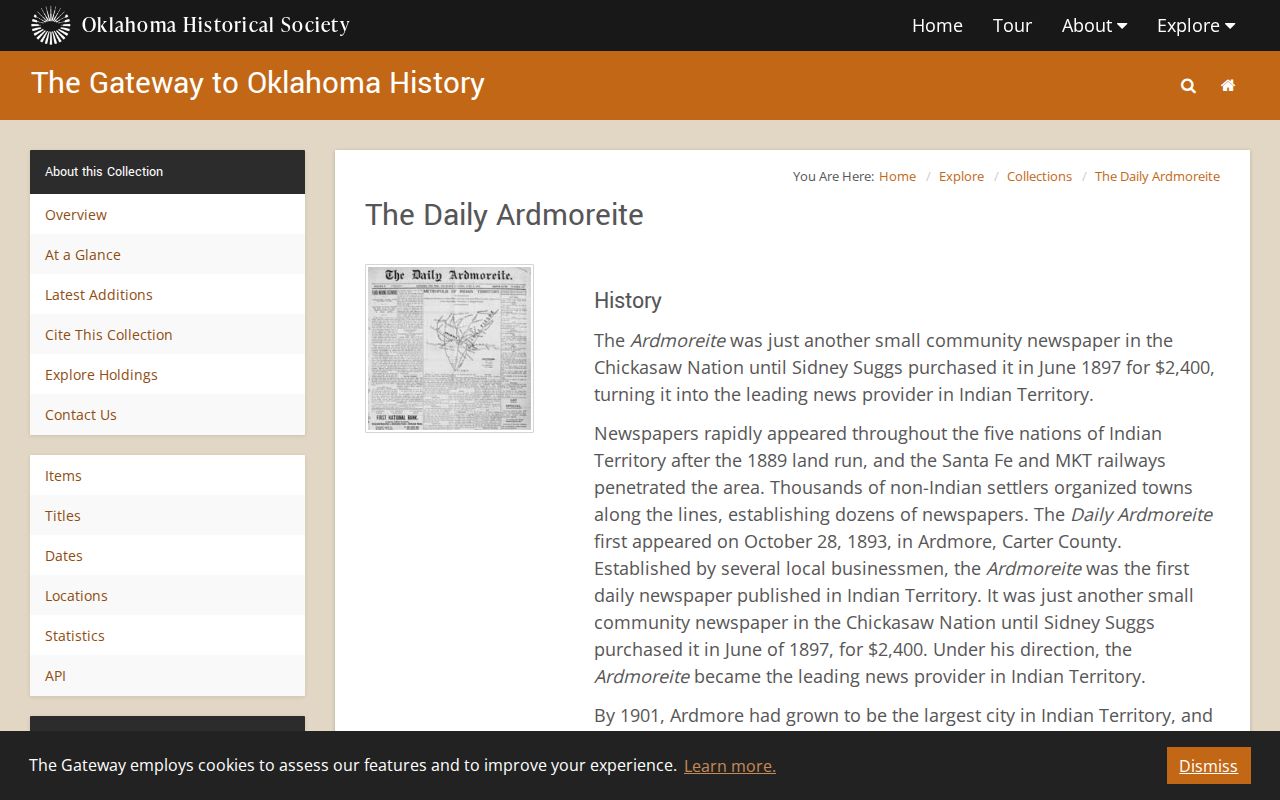
A newspaper notice can provide a date, business, institution, or social reference that helps test a historical entry without turning a single listing into proof of a household relationship.
Note: A Daily Ardmoreite search result should be checked against the page image and nearby issues when OCR leaves a name incomplete.
Trace an Ardmore Household Across Years
Use the annual pattern to trace an Ardmore household, then bring in sources that answer different questions. Start with the Polk volume closest to the target year. Write down the printed name, address, occupation, and section. Look at the prior and later available volumes. A move, a different initial, or a vanished entry becomes a question for an Ardmore map, census, deed, yearbook, obituary, or court record rather than a conclusion.
- Locate the earliest available entry and copy the year, page, name, and address exactly.
- Check the street or householder material in that volume when it exists.
- Move through successive years, keeping a separate line for every changed address or spelling.
- Pair the directory sequence with the relevant census or yearbook period, allowing for changing township and city boundaries.
- Use an obituary, cemetery source, deed, or newspaper item only to corroborate a dated finding.
For a modern parcel or a current street chain, the historical shelf should be paired with the address-specific records on the Ardmore Street Directory page. Note: Directory entries are annual snapshots and cannot establish legal title by themselves.
Ardmore Directory Gaps
Two gaps are important. Research verified the Polk run from 1904 to 1960, but did not verify a first Ardmore printed directory before 1904 or a final year after 1960. It also did not locate a named local criss-cross collection. Ask the Library or OHS reference desk about a particular year, reverse volume, or microfilm reel rather than treating an online search miss as the end of the trail.
Ardmore's record geography also changes around statehood. Carter County was created in 1907, and OHS notes that Indian Territory judicial recording-district books were generally not preserved by state counties. Earlier questions may need territorial court, probate, guardian, citizenship, or archival work. The 1895 fire and the 1915 explosion are useful date anchors for newspaper and local-history searching, but neither fact proves the loss of a particular directory or a particular person's record.